COURSE CODE: TGS-2026062163
About This Course
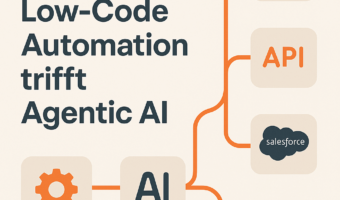
This course offers a comprehensive introduction to Low-Code Agentic AI using n8n, an open-source automation tool that enables users to create intelligent workflows without extensive coding knowledge. Learners will explore how to use n8n to automate complex tasks, integrate AI agents into business processes, and create powerful workflows that enhance productivity and decision-making. Through hands-on exercises, participants will master the essential features of n8n, including connecting multiple platforms, building AI-driven automations, and optimizing operations.
Low-Code AI with n8n provides businesses with the flexibility to streamline operations and reduce manual workloads by automating repetitive tasks. This course is highly relevant for professionals aiming to improve operational efficiency, reduce costs, and enhance customer experience through automation. With the increasing demand for AI-enhanced business processes, this skill set is valuable for anyone seeking to advance their career in the field of business automation, AI development, and digital transformation.
What You’ll Learn
By end of course, learners should be able to:
- LO1 By the end of this learning unit, learners will be able to design sophisticated multi-agent integration workflows using n8n for intelligent AI application development. They will demonstrate proficiency in understanding software integration concepts, integrating multiple generative AI models while addressing compatibility issues, and designing effective model pipelines. Learners will also be capable of creating integration workflows between AI models and systems, including batch processing, API integration, and multi-model orchestration, while resolving compatibility issues with external software and systems.
- LO2 By the end of this learning unit, learners will be able to develop and deploy sophisticated Agentic AI and RAG applications using n8n. They will demonstrate comprehensive understanding of context augmentation techniques such as knowledge graphs, and various approaches to deploy models for inference using cloud platforms. Learners will be proficient in identifying and resolving issues in generative AI models through error log analysis and interpretation, and will be capable of developing applications that integrate generative AI models via developer tools and cloud service offerings such as Streamlit interfaces.
- LO3 By the end of this learning unit, learners will be able to deploy comprehensive guardrails to ensure safe and aligned outputs in Agentic AI applications. They will demonstrate thorough understanding of safeguarding Large Language Models (LLMs) with appropriate guardrails for content generation, and grasp the concepts behind AI governance including how to test and evaluate applications for safety and alignment.
Learners will be proficient in deploying existing guardrails and moderation controls to control inputs and outputs, effectively preventing undesirable model behaviors in their AI applications.
Course Information
Skills Framework: Generative AI Application Development and Deployment ICT-INT-0047-1.1 TSC under Skills Framework
Time: 9am-6pm
Duration: 32hrs (4 days)
Tel: michelle@lauressolutions.com
Email: michelle@lauressolutions.com
FEE & FUNDING
Total Course Fee Per Trainee 2800 (Incl. 9% GST: 3,052)
Category | Actual Fee (Incl GST) | Nett Fee Payable |
Employer Sponsored SG Citizen & SPR | $3,052.00 | $915.60 |
Self-Sponsored SG Citizen > 40 yrs | $3,052.00 | $915.60 |
Self-Sponsored SG Citizen < 40 yrs & SPR | $3,052.00 | $1,526.00 |
Course Certificate
Two e-certificates will be awarded to trainees who have passed the assessment.
- Statement of Achievement
Generative AI Application Development and Deployment ICT-INT-0047-1.1 TSC under Skills Framework
issued by WSG/SSG - Certification of Achievement issued by LAURES SOLUTIONS PTE. LTD..
Course Outline
LU1: Agentic AI App Development with n8n
T1: Introduction to Agentic AI frameworks
T2: Overview of multi-agent n8n workflows
T3: Agentic AI workflow design
T4: Build Agentic AI Applications with Agentic AI frameworks
T5: Development with n8n AI platforms
LU2: Agentic AI and RAG Deployment on n8n
T1: Concepts behind context augmentation techniques
T2: Approaches to deploy models for inference using cloud platforms
T3: Identify issues in Agentic AI pipeline by analysing and interpreting error logs
T4: Deploy RAG and Agentic AI Apps on Streamlit interfaces
LU3: Model Alignment and Guardrails
T1: Safeguarding Large Language Models (LLMs) with guardrails for content generation
T2: Model alignment for safety and alignment
T3: Deploy guardrails on Agentic AI applications
Enquiry
Venue: 051531, 531A UPPER CROSS STREET HONG LIM COMPLEX 04 95
Minimum Entry Requirements
Knowledge and Skills
- Able to operate using computer functions with minimum Computer Literacy
Level 2 based on ICAS Computer Skills Assessment Framework - Minimum 3 GCE ‘O’ Levels Passes including English or WPL Level 5 (Average of Reading, Listening, Speaking & Writing Scores)
Frequently Asked Questionsy
* What are the prerequisites for WSQ Funding?
1. You need to be a Singaporean Citizen or Permanent Resident, physically based in Singapore.
2. You must successfully complete the programme and pass the assessment in order to be eligible.
3. You must attend at least 75% of the training.
* Can I club any other grant with this subsidy?
No, you cannot claim any other grant if you are claiming this subsidy from SSG. You should not be claiming for any other grants, subsidies, or tax concessions, provided unless explicitly permitted.
* Do I need to pay the full fee, and then claim the subsidy from WSQ Funding?
The programme works on a Nett fee model, i.e. you only need to pay the difference between the fee, and the funding amount at the time of enrollment. The training provider (TP) will claim the funding amount from SSG on completion of the programme. In case you fail to complete the programme, or if the claim raised by TP is rejected by SSG then you are liable to pay the funding amount to TP.